Ewald Sphere Construction
The Ewald sphere is a geometric construction in reciprocal space that determines which crystal planes can diffract electrons at a given beam geometry. Rheedium implements both binary and finite-domain Ewald sphere models.
Geometric Construction
Reciprocal Space
For a crystal with real-space lattice vectors \(\mathbf{a}\), \(\mathbf{b}\), \(\mathbf{c}\), the reciprocal lattice vectors are:
where \(V = \mathbf{a} \cdot (\mathbf{b} \times \mathbf{c})\) is the unit cell volume.
Reciprocal lattice vectors are indexed by Miller indices \((h, k, l)\):
The Ewald Sphere
The Ewald sphere is a sphere in reciprocal space with:
Center: At the tip of \(-\mathbf{k}_{\text{in}}\) (the negative incident wavevector)
Radius: \(|\mathbf{k}| = 2\pi/\lambda\) (the wavevector magnitude)
Diffraction Condition
A reciprocal lattice point \(\mathbf{G}\) lies on the Ewald sphere when:
where \(\mathbf{k}_{\text{out}} = \mathbf{k}_{\text{in}} + \mathbf{G}\).
This is the elastic scattering condition: the scattered electron has the same energy as the incident electron.
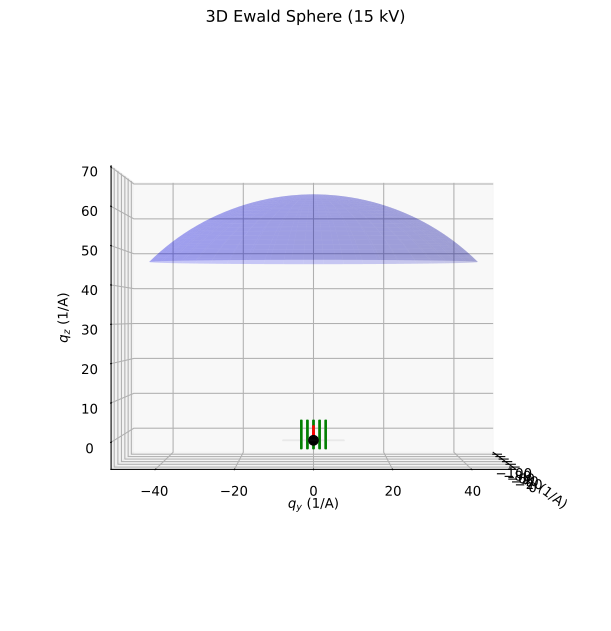
Front view of the Ewald sphere construction in 3D reciprocal space. The sphere (blue) has its center at the tip of \(-\mathbf{k}_{in}\) and radius \(|k| = 2\pi/\lambda\). Diffraction occurs where the sphere intersects reciprocal lattice points or rods.
Incident Wavevector
In RHEED geometry, electrons arrive at grazing angle \(\theta\) with azimuthal orientation \(\phi\):
where:
\(\theta\) = grazing incidence angle (typically 1-5°)
\(\phi\) = azimuthal angle (rotation about surface normal)
\(|\mathbf{k}| = 2\pi/\lambda\)
The small grazing angle creates a nearly tangent intersection with reciprocal lattice rods, producing elongated streaks in the RHEED pattern.
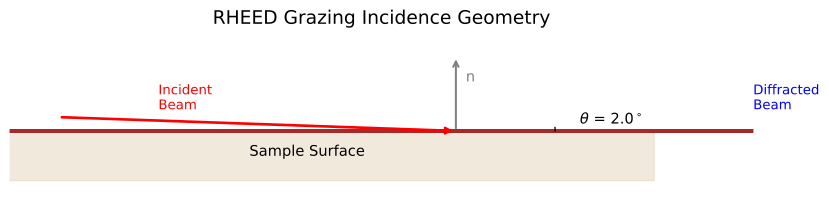
RHEED grazing incidence geometry showing the beam arriving at angle \(\theta\) from the surface. The specularly diffracted beam exits at the same angle on the opposite side.
Binary Mode
The simplest Ewald model uses a tolerance-based criterion for sphere intersection:
where \(\epsilon\) is typically 0.05 (5% tolerance).
Algorithm
For each reciprocal lattice point \(\mathbf{G}\):
Compute \(\mathbf{k}_{\text{out}} = \mathbf{k}_{\text{in}} + \mathbf{G}\)
Check if \(|k_{\text{out}}|\) is within tolerance of \(|k_{\text{in}}|\)
Filter for upward scattering: \(k_{\text{out},z} > 0\)
Return allowed indices and their intensities
Implementation
def ewald_allowed_reflections(
    ewald: EwaldData,
    theta_deg: float,
    phi_deg: float = 0.0,
    tolerance: float = 0.05,
) -> Tuple[Int[Array, "M"], Float[Array, "M 3"], Float[Array, "M"]]:
    """Find reciprocal lattice points satisfying the Ewald condition."""
Finite Domain Mode
Real surfaces have finite coherent domain sizes, and electron beams have energy spread and angular divergence. These effects broaden the Ewald sphere into a shell with finite thickness.
Physical Effects
Effect |
Causes |
Reciprocal Space Consequence |
|---|---|---|
Finite domain size |
Surface defects, terraces |
Rod broadening in \((k_x, k_y)\) |
Energy spread |
Thermionic emission |
Shell thickness in $ |
Beam divergence |
Electron optics |
Shell thickness in direction |
Rod Broadening
A finite coherent domain of extent \(L\) causes reciprocal lattice rods to have Gaussian width:
This follows from the Fourier uncertainty relation: \(\Delta x \cdot \Delta k \approx 2\pi\).
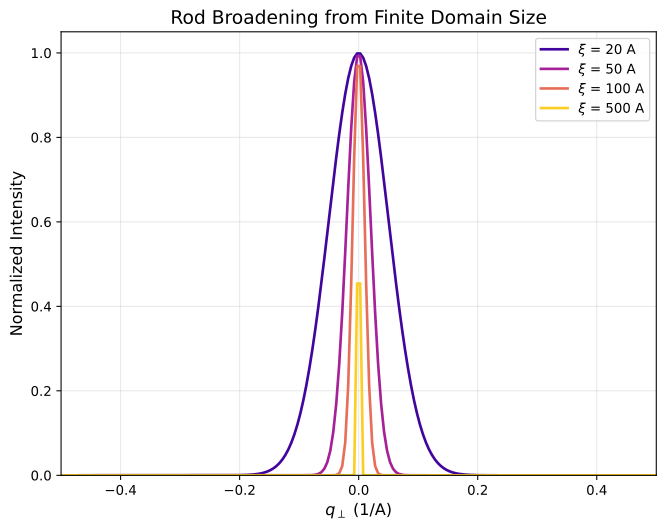
Lateral rod profiles for different coherent domain sizes. Smaller domains produce broader rods in reciprocal space, following the Fourier uncertainty relation \(\Delta x \cdot \Delta k \approx 2\pi\).
Ewald Shell Thickness
Energy spread \(\Delta E/E\) and beam divergence \(\Delta\theta\) combine to give shell thickness:
For typical RHEED conditions (15 kV, thermionic gun):
\(\Delta E/E \approx 10^{-4}\) (energy spread)
\(\Delta\theta \approx 10^{-3}\) rad (divergence)
\(\sigma_{\text{shell}} \approx 0.07\) Å\(^{-1}\)
Overlap Integral
Instead of a binary on/off criterion, finite domain mode computes a continuous overlap:
where:
\(d = ||\mathbf{k}_{\text{out}}| - |\mathbf{k}_{\text{in}}||\) (deviation from elastic condition)
\(\sigma_{\text{eff}}^2 = \sigma_{\text{rod}}^2 + \sigma_{\text{shell}}^2\) (combined broadening)
Implementation
def rod_ewald_overlap(
    k_in: Float[Array, "3"],
    g_vectors: Float[Array, "N 3"],
    rod_sigma: Float[Array, "2"],
    shell_sigma: float,
) -> Float[Array, "N"]:
    """Compute continuous overlap between rods and Ewald shell."""
EwaldData Structure
Rheedium separates angle-independent computations (done once) from angle-dependent computations (done per beam orientation):
Angle-Independent (Precomputed)
Field |
Description |
Units |
|---|---|---|
|
Electron wavelength |
Å |
|
Wavevector magnitude \(2\pi/\lambda\) |
Å\(^{-1}\) |
|
Ewald sphere radius (= $ |
k |
|
Reciprocal lattice basis \([\mathbf{a}^*, \mathbf{b}^*, \mathbf{c}^*]\) |
Å\(^{-1}\) |
|
Miller indices \([N \times 3]\) |
dimensionless |
|
Reciprocal lattice vectors \([N \times 3]\) |
Å\(^{-1}\) |
|
$ |
\mathbf{G} |
|
\(F(\mathbf{G})\) for each point |
complex |
|
$ |
F(\mathbf{G}) |
Angle-Dependent (Per Orientation)
Quantity |
Description |
|---|---|
\(\mathbf{k}_{\text{in}}\) |
Incident wavevector from \(\theta\), \(\phi\) |
Allowed indices |
Which \(\mathbf{G}\) satisfy Ewald condition |
\(\mathbf{k}_{\text{out}}\) |
Outgoing wavevectors |
Detector coordinates |
Projection onto screen |
Efficiency
By precomputing structure factors, an azimuthal scan (varying \(\phi\) at fixed \(\theta\)) only requires:
Rotating \(\mathbf{k}_{\text{in}}\)
Finding new Ewald intersections
Looking up precomputed intensities
This avoids recomputing atomic form factors and structure factors at each angle.
Building EwaldData
from rheedium.simul import build_ewald_data

ewald = build_ewald_data(
    crystal=my_crystal,        # CrystalStructure
    voltage_kv=15.0,           # Accelerating voltage
    hmax=3, kmax=3, lmax=2,    # Miller index bounds
    temperature=300.0,         # For Debye-Waller factors
    use_debye_waller=True,     # Include thermal damping
)

# Access precomputed data
print(f"Wavelength: {ewald.wavelength_ang:.4f} Å")
print(f"Number of G vectors: {len(ewald.g_vectors)}")
Finding Allowed Reflections
from rheedium.simul import ewald_allowed_reflections

# Binary mode (tolerance-based)
indices, k_out, intensities = ewald_allowed_reflections(
    ewald=ewald,
    theta_deg=2.0,      # Grazing angle
    phi_deg=0.0,        # Azimuthal angle
    tolerance=0.05,     # 5% tolerance
)

print(f"Found {len(indices)} allowed reflections")
Finite Domain Intensities
from rheedium.simul import finite_domain_intensities

overlap, weighted_intensities = finite_domain_intensities(
    ewald=ewald,
    theta_deg=2.0,
    phi_deg=0.0,
    domain_extent_ang=[100.0, 100.0, 50.0],  # Domain size in Å
    energy_spread_frac=1e-4,                  # Relative energy spread
    beam_divergence_rad=1e-3,                 # Beam divergence in radians
)

# overlap values range from 0 (no intersection) to 1 (exact)
Ewald Sphere Visualizations
The Ewald sphere construction can be viewed from multiple angles to understand the geometry:

2D cross-section (xz plane) of the Ewald sphere construction. The incident beam comes from the left at grazing angle, and the sphere intersects vertical reciprocal lattice rods. Each intersection corresponds to a diffraction spot.
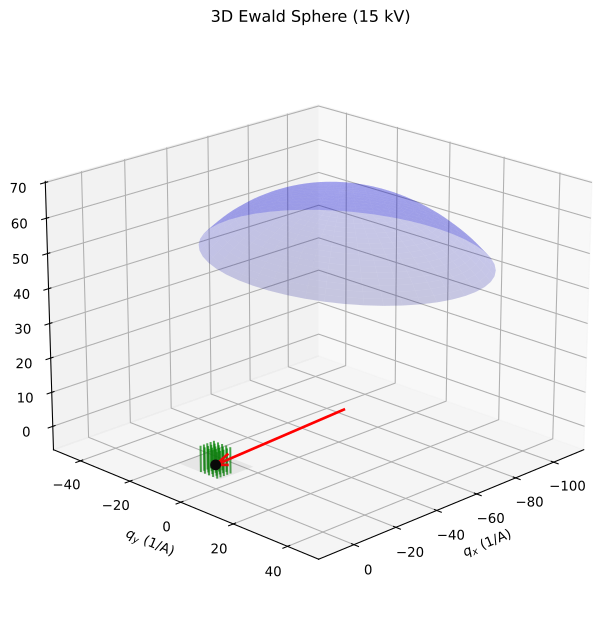
3D perspective view of the Ewald sphere with reciprocal lattice rods. The partial sphere surface shows where the beam energy constrains possible scattering directions.
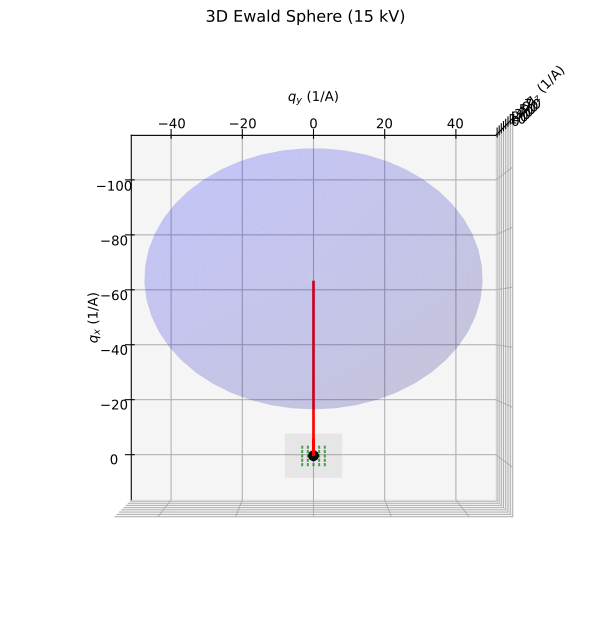
Top-down view looking along the surface normal. The circular intersection of the Ewald sphere with the plane of rod positions determines which reflections appear on the RHEED screen.
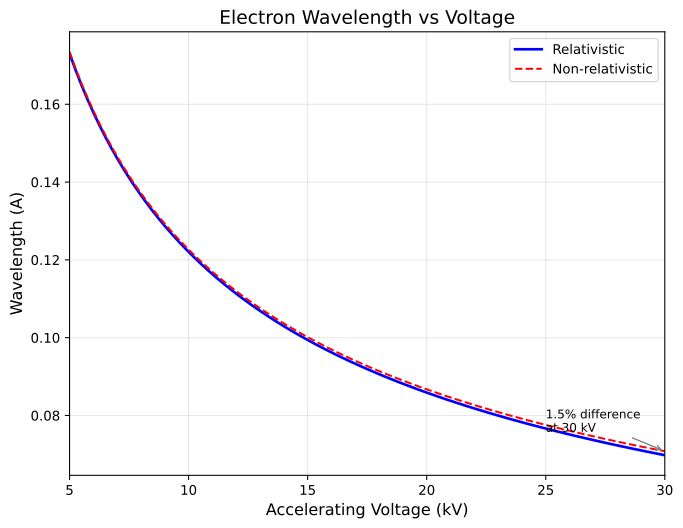
Electron wavelength as a function of accelerating voltage. The Ewald sphere radius \(|k| = 2\pi/\lambda\) increases with voltage, affecting which reflections satisfy the diffraction condition at a given geometry.
Key Source Files
simul/ewald.py- Ewald sphere geometry andbuild_ewald_data()simul/finite_domain.py- Finite domain overlap calculationssimul/simul_utils.py- Wavevector utilities