Kinematic Scattering Theory
Kinematic scattering theory provides the foundation for RHEED pattern simulation in rheedium. This guide covers the mathematical framework, from electron wavelength to diffraction intensities.
The Kinematic Approximation
Kinematic theory assumes that electrons scatter at most once as they traverse the crystal. This single-scattering approximation is valid when:
The crystal is thin (surface-sensitive RHEED geometry)
Scattering is weak (high-energy electrons, ~10-30 keV)
Only relative intensities matter (not absolute cross-sections)
For quantitative analysis of strong reflections or thick samples, dynamical (multiple scattering) theory is required, but kinematic theory captures the essential physics of RHEED patterns.
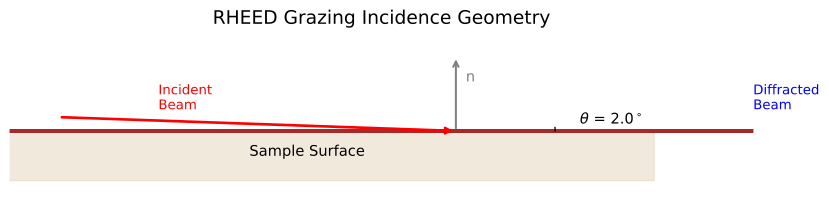
RHEED geometry showing the electron beam arriving at grazing angle \(\theta\) from the sample surface. The surface-sensitive nature of RHEED arises from this shallow incident angle, which limits electron penetration to just a few atomic layers.
Relativistic Electron Wavelength
At RHEED energies (typically 10-30 keV), electrons are mildly relativistic. The de Broglie wavelength must include relativistic corrections:
where:
\(h = 6.626 \times 10^{-34}\) J·s (Planck’s constant)
\(m_0 = 9.109 \times 10^{-31}\) kg (electron rest mass)
\(e = 1.602 \times 10^{-19}\) C (electron charge)
\(V\) = accelerating voltage (V)
\(c = 2.998 \times 10^8\) m/s (speed of light)
Numerical Values
Voltage (kV) |
Wavelength (Å) |
Relativistic Correction |
|---|---|---|
10 |
0.1220 |
0.98% |
15 |
0.0994 |
1.47% |
20 |
0.0859 |
1.96% |
30 |
0.0698 |
2.93% |
The relativistic correction \(eV/(2m_0c^2)\) is small but non-negligible for accurate simulations.
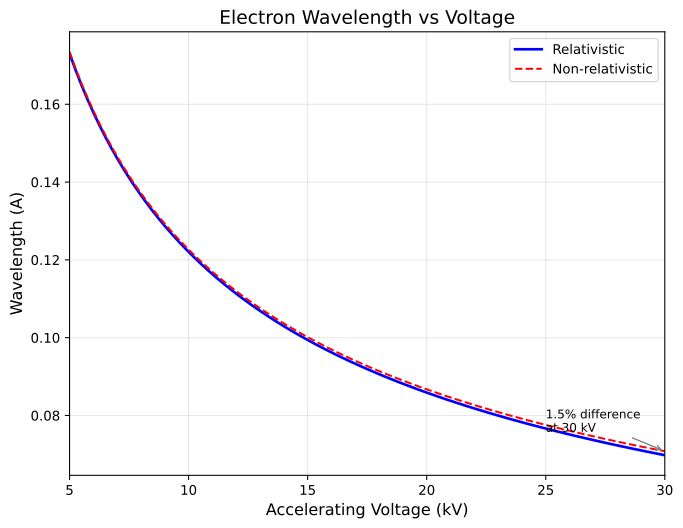
Relativistic electron wavelength as a function of accelerating voltage. The dashed line shows the non-relativistic approximation, which overestimates the wavelength by several percent at typical RHEED energies.
Implementation
In rheedium, wavelength calculation is in simul/simul_utils.py:
def wavelength_ang(voltage_kv: float) -> float:
    """Relativistic electron wavelength in Angstroms."""
    voltage_v = voltage_kv * 1000.0
    # Relativistic correction factor
    gamma = 1.0 + e * voltage_v / (2.0 * m_e * c**2)
    return h / jnp.sqrt(2.0 * m_e * e * voltage_v * gamma) * 1e10
Structure Factor
The structure factor \(F(\mathbf{G})\) encodes how atoms in the unit cell scatter into a reciprocal lattice vector \(\mathbf{G}\):
where:
\(f_j(|\mathbf{G}|)\) = atomic form factor for atom \(j\) (see Form Factors)
\(\exp(-W_j)\) = Debye-Waller thermal damping factor
\(\mathbf{r}_j\) = position of atom \(j\) in the unit cell
\(N\) = number of atoms in the unit cell
Physical Interpretation
Each term in the sum represents:
Scattering amplitude \(f_j\): How strongly atom \(j\) scatters electrons (depends on atomic number and scattering angle)
Thermal damping \(\exp(-W_j)\): Reduction due to thermal vibrations (stronger at large \(|\mathbf{G}|\))
Phase factor \(\exp(i\mathbf{G}\cdot\mathbf{r}_j)\): Interference from atom positions
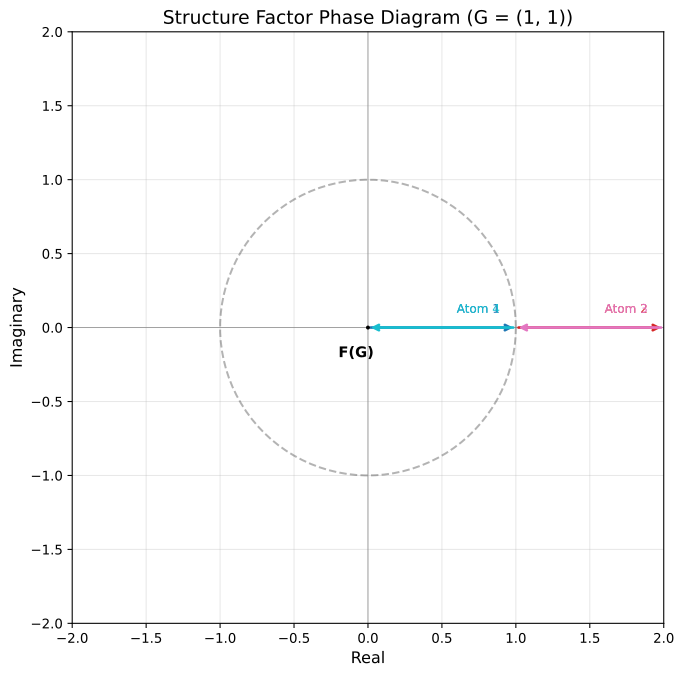
Argand diagram showing how phase factors from different atoms combine to form the total structure factor. Each arrow represents one atom’s contribution, and their vector sum gives \(F(\mathbf{G})\).
Extinction Rules
The structure factor determines which reflections are allowed. For example:
BCC lattice: \(F = 0\) when \(h + k + l\) is odd
FCC lattice: \(F = 0\) unless \(h, k, l\) are all even or all odd
Diamond structure: Additional extinctions when \(h + k + l = 4n + 2\)
These arise from destructive interference in the phase factor sum.
Diffraction Intensity
The measured intensity is proportional to the squared modulus of the structure factor:
This assumes:
Kinematic (single-scattering) conditions
Incoherent summation over thermal vibrations (absorbed in Debye-Waller factor)
No absorption or anomalous dispersion
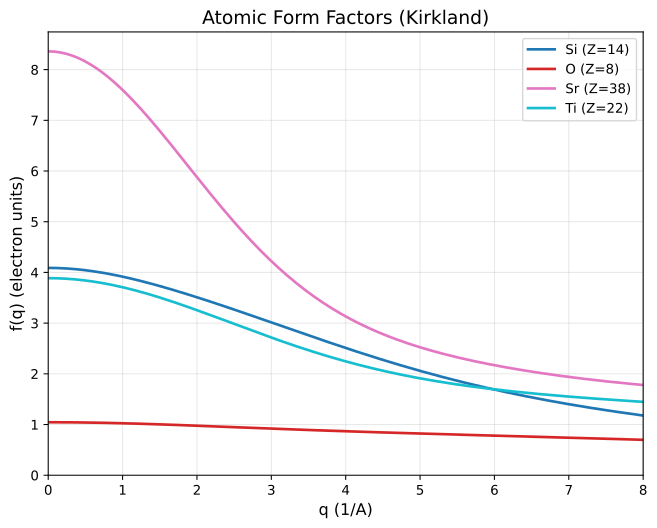
Atomic form factors \(f(q)\) for several elements showing how scattering amplitude decreases with momentum transfer. Heavier elements scatter more strongly, but all form factors approach zero at high \(q\).
Simplified vs Full Structure Factors
Rheedium provides two approaches for structure factor calculation:
Simplified Model
Uses atomic number as a proxy for scattering amplitude:
Advantages: Fast, no external tables needed
Limitations: Ignores \(q\)-dependence of form factors, no thermal effects
Use case: Quick pattern visualization, qualitative comparisons
Full Model (Kirkland Form Factors)
Uses tabulated electron scattering form factors with thermal corrections:
Advantages: Quantitatively accurate intensities
Limitations: Requires form factor tables, more computation
Use case: Comparison with experimental data, intensity analysis
See Form Factors for details on the Kirkland parameterization.
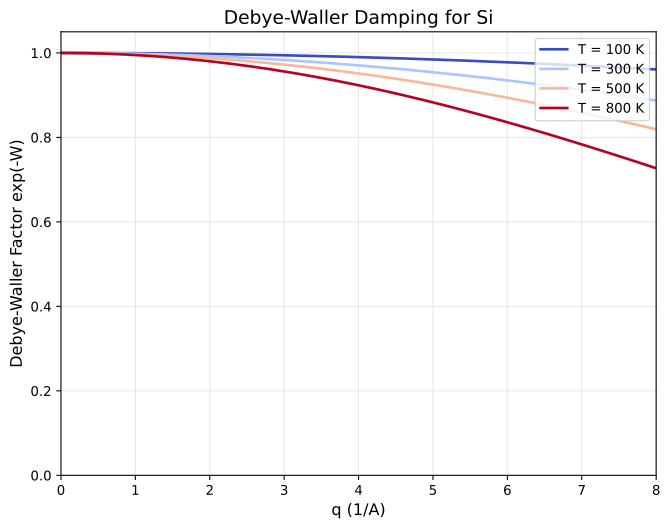
Debye-Waller damping factor \(\exp(-W)\) at different temperatures. Higher temperatures increase atomic vibrations, causing stronger damping of high-\(q\) reflections and reducing the intensity of high-order diffraction spots.
Crystal Truncation Rods (CTRs)
For surface-sensitive RHEED, the reciprocal lattice consists of continuous rods perpendicular to the surface, not discrete points. This arises from the abrupt surface termination.
Physical Origin
A semi-infinite crystal can be modeled as an infinite crystal multiplied by a step function \(\Theta(z)\):
In reciprocal space, this convolution becomes:
The Fourier transform of the step function is proportional to \(1/q_z\), creating continuous intensity along the surface-normal direction.
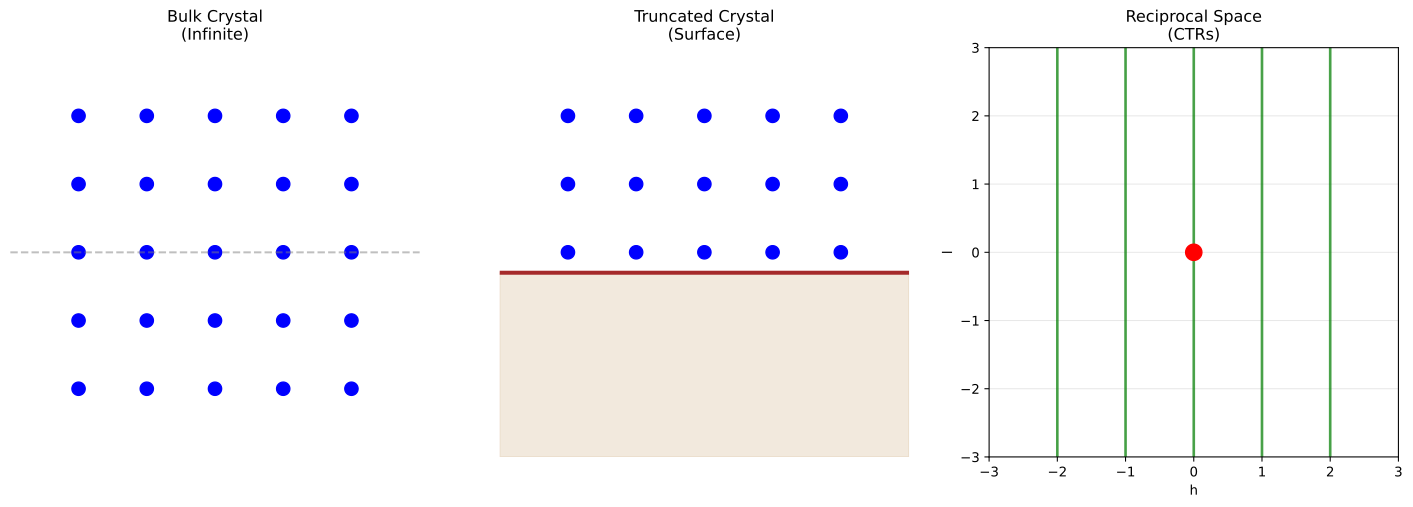
Origin of crystal truncation rods: (left) bulk crystal with 3D periodicity produces discrete Bragg peaks, (center) surface truncation breaks z-periodicity, (right) reciprocal space shows continuous rods instead of discrete points.
CTR Intensity Modulation
Along a rod at fixed \((h, k)\), the intensity varies as:
The \(1/\sin^2(\pi l)\) factor produces:
Divergence at integer \(l\): Bragg peaks from bulk periodicity
Finite intensity between Bragg peaks: Surface truncation rods
Minimum at half-integer \(l\): Anti-Bragg conditions
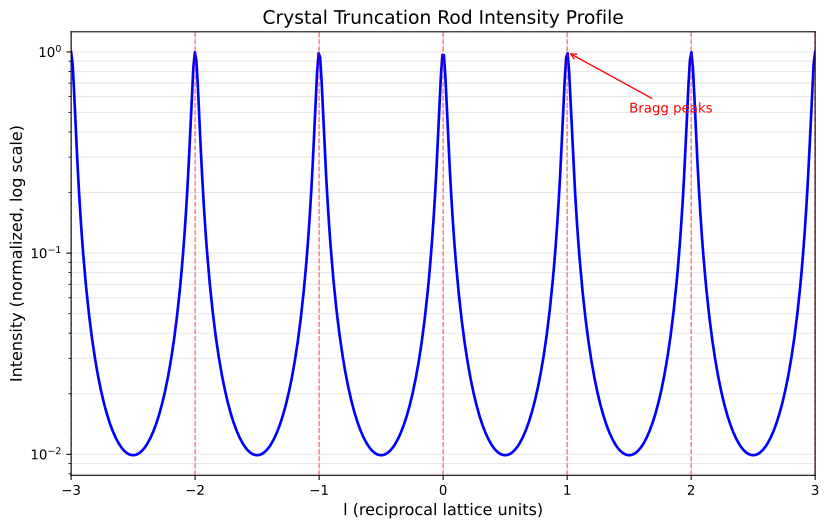
CTR intensity profile showing the characteristic \(1/\sin^2(\pi l)\) modulation. Intensity diverges at Bragg peak positions (integer \(l\)) and reaches minima at anti-Bragg conditions.
Implementation
The CTR simulator in simul/kinematic.py uses kinematic_ctr_simulator():
def kinematic_ctr_simulator(
    crystal: CrystalStructure,
    voltage_kv: float,
    theta_deg: float,
    phi_deg: float = 0.0,
    hmax: int = 3,
    kmax: int = 3,
    l_points: int = 100,
    detector_distance: float = 100.0,
) -> RHEEDPattern:
    """Simulate RHEED with continuous CTR sampling."""
Ewald Sphere Intersection
The Ewald sphere determines which reciprocal lattice points (or rod positions) contribute to the diffraction pattern at a given beam geometry. See Ewald Sphere for the full treatment.
Diffraction Condition
A reflection \(\mathbf{G}\) is allowed when:
where:
This ensures elastic scattering (energy conservation).
Grazing Incidence Geometry
In RHEED, the incident beam arrives at grazing angle \(\theta\) (typically 1-5°):
The small \(\theta\) creates a nearly tangent intersection of the Ewald sphere with reciprocal lattice rods, producing the characteristic streaked RHEED pattern.

2D cross-section of the Ewald sphere construction in RHEED geometry. The incident beam (red arrow) arrives at grazing angle, and the sphere intersects vertical reciprocal lattice rods. Each intersection corresponds to a diffraction spot on the detector.
Detector Projection
Outgoing wavevectors \(\mathbf{k}_{\text{out}}\) are projected onto a flat detector screen:
where \(d\) is the sample-to-detector distance.
Only forward-scattered electrons (\(k_{\text{out},x} > 0\)) and upward-going electrons (\(k_{\text{out},z} > 0\)) reach the detector.
Workflow Summary
CrystalStructure
      ↓
┌─────────────────────────────────────┐
│ 1. Compute wavelength from voltage  │
│    λ = h / √(2m₀eV(1 + eV/2m₀c²))  │
└─────────────────────────────────────┘
      ↓
┌─────────────────────────────────────┐
│ 2. Generate reciprocal lattice      │
│    G(h,k,l) = h·a* + k·b* + l·c*   │
└─────────────────────────────────────┘
      ↓
┌─────────────────────────────────────┐
│ 3. Compute structure factors        │
│    F(G) = Σⱼ fⱼ exp(-Wⱼ) exp(iG·rⱼ)│
└─────────────────────────────────────┘
      ↓
┌─────────────────────────────────────┐
│ 4. Find Ewald sphere intersections  │
│    |k_out| = |k_in|                │
└─────────────────────────────────────┘
      ↓
┌─────────────────────────────────────┐
│ 5. Project onto detector screen     │
│    (Y, Z) = d · (k_y, k_z) / k_x   │
└─────────────────────────────────────┘
      ↓
RHEEDPattern
Visualizing the RHEED Pattern
The kinematic theory produces actual diffraction patterns. Here’s a complete example from CIF file to rendered pattern:
import rheedium as rh

# Load crystal structure
crystal = rh.io.parse_cif("MgO.cif")

# Simulate at 2° grazing incidence
pattern = rh.simul.kinematic_simulator(
    crystal,
    voltage_kv=15.0,
    theta_deg=2.0,
    phi_deg=0.0,
    hmax=5,
    kmax=5,
    surface_roughness=0.3,
)

# Render the pattern
rh.plots.plot_rheed(
    pattern,
    grid_size=400,
    spot_width=0.03,
    cmap_name="phosphor",
)
Simulated MgO RHEED pattern at 2° grazing incidence along the [100] azimuth. The vertical Laue zones and horizontal Kikuchi lines arise from kinematic scattering theory. Spot intensities are modulated by the structure factor \(|F(\mathbf{G})|^2\).
Effect of Structure Factor on Pattern
The structure factor determines which reflections are allowed and their intensities:
import rheedium as rh

# Compare rock salt (MgO) vs. perovskite (SrTiO3) patterns
for cif_file, title in [
    ("MgO.cif", "Rock salt (MgO)"),
    ("SrTiO3.cif", "Perovskite (SrTiO₃)")
]:
    crystal = rh.io.parse_cif(cif_file)
    pattern = rh.simul.kinematic_simulator(
        crystal,
        voltage_kv=15.0,
        theta_deg=2.0,
        hmax=5,
        kmax=5,
    )
    rh.plots.plot_rheed(pattern, cmap_name="phosphor")
RHEED patterns from two crystal structures demonstrating how the structure factor \(F(\mathbf{G})\) controls spot positions and intensities. MgO (rock salt) shows systematic absences different from SrTiO₃ (perovskite).
Key Source Files
simul/kinematic.py- Main simulation functionssimul/simulator.py- Intensity calculations with CTRssimul/simul_utils.py- Wavelength and wavevector utilities