Unit Cell Operations
This guide covers crystallographic operations on unit cells: lattice vector construction, reciprocal space, supercells, and surface slab generation for RHEED simulation.
Lattice Vector Construction
From Cell Parameters
Given cell parameters \((a, b, c, \alpha, \beta, \gamma)\), rheedium constructs lattice vectors in the standard crystallographic convention:
\(\mathbf{a}\) along the \(x\)-axis
\(\mathbf{b}\) in the \(xy\)-plane
\(\mathbf{c}\) determined by angles
Mathematical Construction
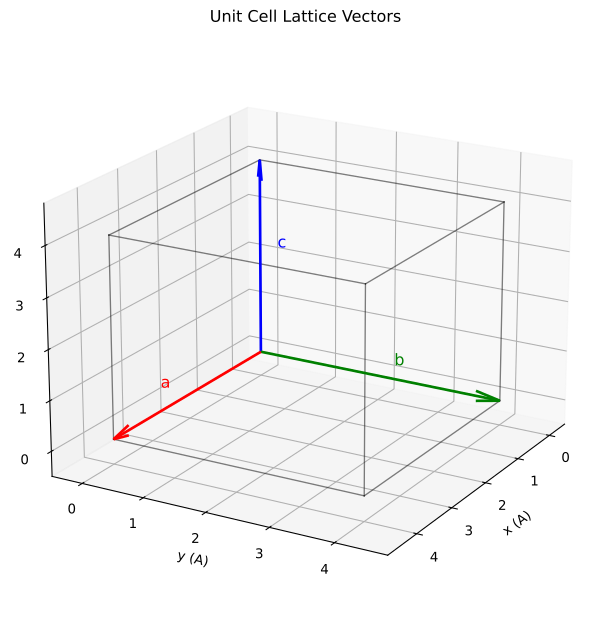
3D visualization of unit cell lattice vectors \(\mathbf{a}\) (red), \(\mathbf{b}\) (green), and \(\mathbf{c}\) (blue) for a cubic cell. The vectors form the edges of the parallelepiped unit cell.
Implementation
from rheedium.ucell import build_cell_vectors

# Cubic cell (e.g., MgO)
lattice_cubic = build_cell_vectors(
    a=4.21, b=4.21, c=4.21,
    alpha=90.0, beta=90.0, gamma=90.0,
)
# Returns:
# [[4.21, 0.00, 0.00],
#  [0.00, 4.21, 0.00],
#  [0.00, 0.00, 4.21]]

# Hexagonal cell
lattice_hex = build_cell_vectors(
    a=3.0, b=3.0, c=5.0,
    alpha=90.0, beta=90.0, gamma=120.0,
)
# Returns:
# [[ 3.00,  0.00, 0.00],
#  [-1.50,  2.60, 0.00],
#  [ 0.00,  0.00, 5.00]]
Extracting Cell Parameters
The inverse operation extracts parameters from vectors:
from rheedium.ucell import compute_lengths_angles

a, b, c, alpha, beta, gamma = compute_lengths_angles(lattice)
Formulas
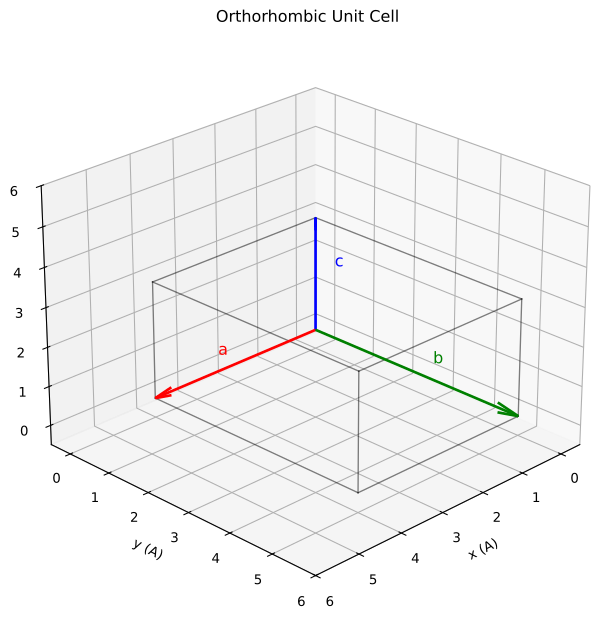
An orthorhombic unit cell showing the three lattice vectors \(\mathbf{a}\), \(\mathbf{b}\), \(\mathbf{c}\) with all angles at 90°. Different crystal systems have different constraints on the lengths and angles.
Reciprocal Lattice
Definition
The reciprocal lattice vectors satisfy:
where \(\mathbf{a}_i\) are real-space vectors and \(\mathbf{b}_j\) are reciprocal vectors.
Explicit Formulas
where the unit cell volume is:
Implementation
from rheedium.ucell import reciprocal_lattice_vectors

recip = reciprocal_lattice_vectors(lattice)
# recip[i] is the i-th reciprocal lattice vector (Å⁻¹)

# Verify orthogonality
import jax.numpy as jnp
dot_product = lattice @ recip.T  # Should be 2π × identity
Generating Reciprocal Lattice Points
from rheedium.ucell import generate_reciprocal_points

# Generate all (h,k,l) within bounds
hkl_grid, g_vectors = generate_reciprocal_points(
    recip_vectors=recip,
    hmax=3, kmax=3, lmax=2,
)
# hkl_grid: [N, 3] integer Miller indices
# g_vectors: [N, 3] reciprocal space vectors (Å⁻¹)
Miller Indices
Notation
Miller indices \((hkl)\) describe planes perpendicular to \(\mathbf{G}_{hkl}\):
Physical Interpretation
Indices |
Meaning |
|---|---|
\((100)\) |
Planes perpendicular to \(\mathbf{a}^*\) (parallel to \(bc\) face) |
\((110)\) |
Diagonal planes |
\((111)\) |
Body-diagonal planes (important for FCC, BCC) |
\((00l)\) |
Planes parallel to the surface (for \(l\) non-zero) |
Direction Notation
Square brackets \([hkl]\) denote directions (parallel to \(h\mathbf{a} + k\mathbf{b} + l\mathbf{c}\)).
For RHEED, the surface normal is typically along \([001]\) (the \(\mathbf{c}\)-axis).
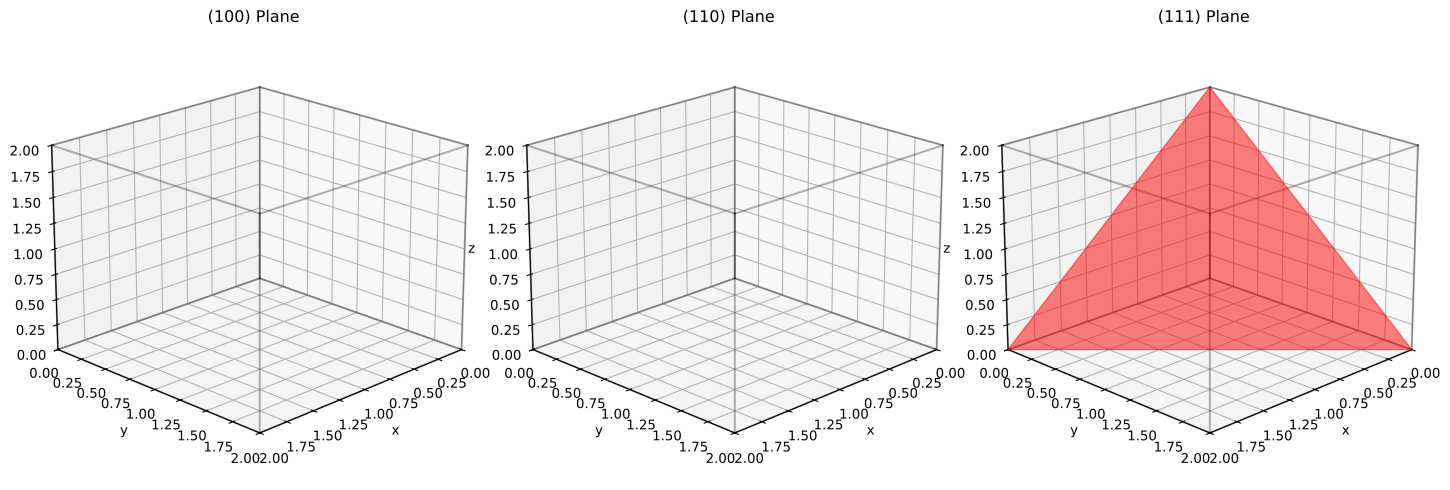
Miller index planes in a cubic unit cell: (100), (110), and (111). Each plane is perpendicular to the corresponding reciprocal lattice vector.
Supercell Generation
Supercells are created by replicating the unit cell:
2D Supercell (In-Plane)
For RHEED, we typically expand in the surface plane only:
from rheedium.ucell import make_supercell

# Create a 3×3×1 supercell
supercell = make_supercell(
    crystal=unit_cell,
    nx=3, ny=3, nz=1,
)
# supercell has 9× the atoms, with scaled lattice vectors
Lattice Vector Scaling
Position Replication
For each atom at \(\mathbf{r}\) in the original cell, the supercell contains atoms at:
for \(i = 0, \ldots, n_x-1\), etc.
Surface Slab Construction
RHEED simulates diffraction from a surface-oriented slab. This requires rotating the crystal so the desired surface normal aligns with the \(z\)-axis.
Surface Orientation
Given a surface defined by Miller indices \((hkl)\), the surface normal is:
Rotation to Align with z-Axis
Rheedium constructs a rotation matrix \(\mathbf{R}\) such that:
All atomic positions are then transformed:
Implementation
from rheedium.ucell import build_surface_slab

# Create a (001) surface slab
slab_001 = build_surface_slab(
    crystal=bulk_crystal,
    orientation=[0, 0, 1],  # (001) surface
    depth=20.0,             # Slab thickness in Å
    vacuum=10.0,            # Vacuum spacing in Å
)

# Create a (110) surface slab
slab_110 = build_surface_slab(
    crystal=bulk_crystal,
    orientation=[1, 1, 0],  # (110) surface
    depth=20.0,
)
SlicedCrystal Structure
The result is a SlicedCrystal PyTree:
@register_pytree_node_class
class SlicedCrystal(NamedTuple):
    cart_positions: Float[Array, "N 4"]  # Rotated Cartesian coords + Z
    cell_lengths: Float[Array, "3"]       # Supercell dimensions
    cell_angles: Float[Array, "3"]        # Typically [90, 90, 90]
    orientation: Int[Array, "3"]          # [h, k, l] of surface
    depth: float                          # Slab thickness (Å)
    x_extent: float                       # Lateral size in x (Å)
    y_extent: float                       # Lateral size in y (Å)
Atom Scraping by Depth
For RHEED, only atoms near the surface contribute to scattering:
from rheedium.ucell import atom_scraper

# Keep only atoms within 30 Å of the surface
surface_atoms = atom_scraper(
    crystal=slab,
    thickness=30.0,  # Å from top surface
)
This reduces computation by excluding deeply buried atoms.
Lattice Systems
Seven Crystal Systems
System |
Constraints |
Example |
|---|---|---|
Cubic |
\(a = b = c\), \(\alpha = \beta = \gamma = 90°\) |
NaCl, MgO |
Tetragonal |
\(a = b \neq c\), all angles 90° |
SrTiO₃, rutile |
Orthorhombic |
\(a \neq b \neq c\), all angles 90° |
Olivine |
Hexagonal |
\(a = b \neq c\), \(\gamma = 120°\), others 90° |
Graphite, ZnO |
Trigonal |
\(a = b = c\), \(\alpha = \beta = \gamma \neq 90°\) |
Quartz |
Monoclinic |
\(\alpha = \gamma = 90°\), \(\beta \neq 90°\) |
Gypsum |
Triclinic |
No constraints |
Feldspar |
Convenience Functions
from rheedium.ucell import (
    cubic_cell,
    tetragonal_cell,
    hexagonal_cell,
)

# Quick cubic cell
lattice = cubic_cell(a=4.21)

# Tetragonal cell
lattice = tetragonal_cell(a=3.905, c=3.905)

# Hexagonal cell
lattice = hexagonal_cell(a=3.0, c=5.0)
Coordinate Wrapping
Fractional coordinates should be in [0, 1) for proper periodicity:
from rheedium.ucell import wrap_to_unit_cell

# Wrap fractional coordinates to [0, 1)
wrapped = wrap_to_unit_cell(frac_positions)
# Uses modulo operation: wrapped = frac_positions % 1.0
This is automatically applied during symmetry expansion and supercell generation.
Volume and Density
Unit Cell Volume
from rheedium.ucell import cell_volume

vol = cell_volume(lattice)  # ų
Density Calculation
where \(M_j\) is atomic mass and \(N_A\) is Avogadro’s number.
Workflow: Bulk to Surface Simulation
┌─────────────────────────────────────────────────────────────────┐
│                     1. LOAD BULK CRYSTAL                         │
├─────────────────────────────────────────────────────────────────┤
│  crystal = parse_cif("bulk.cif")                                │
│  • Cell parameters: a, b, c, α, β, γ                            │
│  • Atomic positions: frac_positions, cart_positions             │
└───────────────────────────────────┬─────────────────────────────┘
                                    │
                                    ▼
┌─────────────────────────────────────────────────────────────────┐
│                  2. BUILD SURFACE SLAB                           │
├─────────────────────────────────────────────────────────────────┤
│  slab = build_surface_slab(                                     │
│      crystal,                                                   │
│      orientation=[0, 0, 1],  # (001) surface                    │
│      depth=50.0,             # 50 Å thick                       │
│  )                                                              │
│  • Rotate to align [001] with z-axis                            │
│  • Create supercell for in-plane periodicity                    │
└───────────────────────────────────┬─────────────────────────────┘
                                    │
                                    ▼
┌─────────────────────────────────────────────────────────────────┐
│                  3. GENERATE RECIPROCAL SPACE                    │
├─────────────────────────────────────────────────────────────────┤
│  recip = reciprocal_lattice_vectors(slab.cell_vectors)          │
│  hkl, g_vectors = generate_reciprocal_points(recip, ...)        │
│  • Reciprocal lattice for diffraction geometry                  │
└───────────────────────────────────┬─────────────────────────────┘
                                    │
                                    ▼
┌─────────────────────────────────────────────────────────────────┐
│                    4. RHEED SIMULATION                           │
├─────────────────────────────────────────────────────────────────┤
│  ewald = build_ewald_data(slab, voltage_kv=15.0, ...)           │
│  pattern = kinematic_spot_simulator(slab, ewald, theta=2.0)     │
└─────────────────────────────────────────────────────────────────┘
Key Source Files
ucell/unitcell.py- Lattice construction, reciprocal spaceucell/helper.py- Supercells, surface slabs, atom scrapingtypes/rheed_types.py- SlicedCrystal definition