Crystal Truncation Rods and Surface Effects
Crystal truncation rods (CTRs) are the hallmark of surface-sensitive diffraction. This guide covers the physics of CTRs, roughness effects, and finite coherent domain modeling.
Origin of Crystal Truncation Rods
Bulk vs Surface Diffraction
A bulk 3D crystal produces discrete Bragg peaks at reciprocal lattice points \(\mathbf{G}_{hkl}\). When the crystal is truncated at a surface, the periodicity is broken along the surface-normal direction, creating continuous rods of intensity.
Mathematical Derivation
Consider a semi-infinite crystal extending from \(z = -\infty\) to \(z = 0\):
where \(\Theta\) is the Heaviside step function.
In reciprocal space, this convolution becomes:
The Fourier transform of the step function gives:
This \(1/q_z\) dependence creates continuous intensity along rods perpendicular to the surface.

The Ewald sphere intersects crystal truncation rods at non-integer \(l\) values. Each intersection produces a diffraction spot, with intensity modulated by the CTR profile along the rod.
CTR Intensity Profile
For a surface-terminated crystal, the intensity along a rod at fixed \((h, k)\) varies as:
where:
\(F(h, k, l)\) = structure factor at this reciprocal space point
\(l\) = continuous (non-integer) Miller index along the rod
Features of the CTR Profile
Position |
\(\sin^2(\pi l)\) |
Intensity |
Physical Meaning |
|---|---|---|---|
\(l = 0, 1, 2, ...\) |
0 |
\(\to \infty\) |
Bulk Bragg peaks |
\(l = 0.5, 1.5, ...\) |
1 |
Minimum |
Anti-Bragg condition |
Intermediate |
Varies |
Moderate |
Surface truncation signal |
The divergence at integer \(l\) is regularized by the crystal’s finite thickness and instrumental broadening.
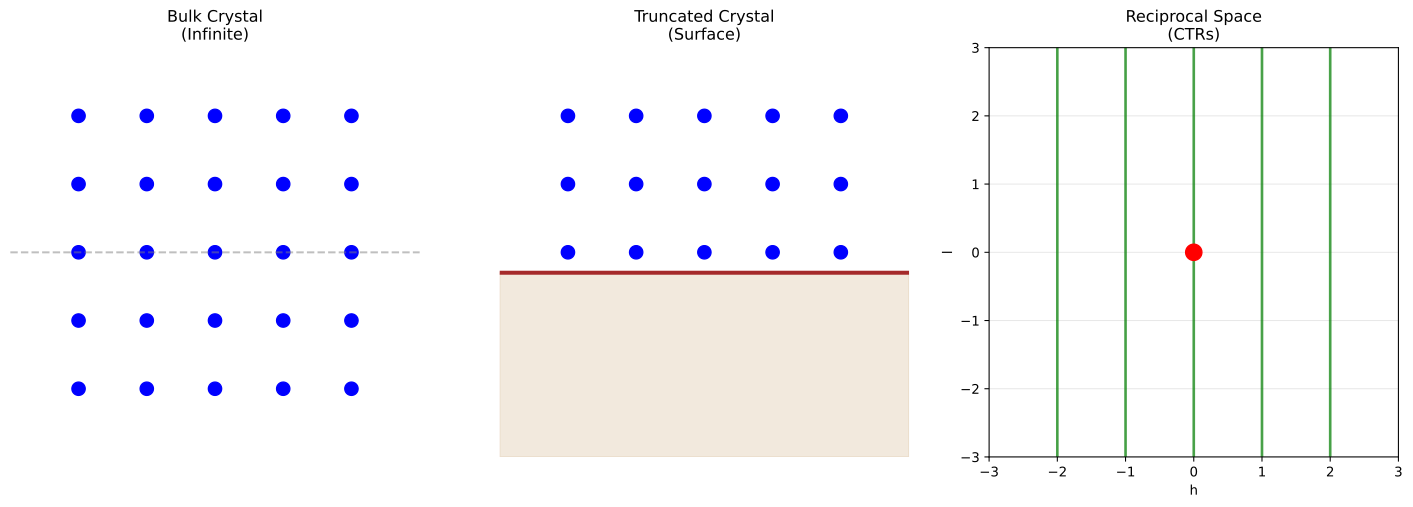
Origin of crystal truncation rods: (left) bulk crystal with 3D periodicity, (center) surface truncation breaks z-periodicity, (right) reciprocal space shows continuous rods instead of discrete points.
Surface Roughness
Real surfaces are not perfectly flat. Surface roughness modifies the CTR intensity.
Gaussian Height Distribution
For a surface with RMS roughness \(\sigma_h\), the height distribution is:
Roughness Damping Factor
Roughness reduces CTR intensity, especially at large \(q_z\):
or equivalently:
Physical Interpretation
Smooth surface (\(\sigma_h \to 0\)): No damping, sharp CTRs
Rough surface (large \(\sigma_h\)): Strong damping at high \(q_z\)
Typical values: \(\sigma_h \approx 1\)–\(5\) Å for epitaxial surfaces
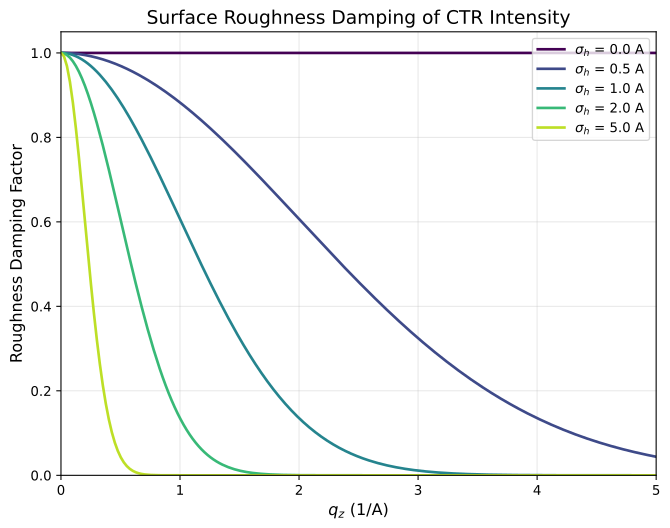
Surface roughness damping factor for different RMS roughness values \(\sigma_h\). Rougher surfaces show stronger attenuation of CTR intensity at large momentum transfer \(q_z\).
Implementation
from rheedium.simul.surface_rods import roughness_damping

# q_z values along a rod
q_z = jnp.linspace(0, 5, 100)  # Å⁻¹

# Roughness damping for σ_h = 2 Å
damping = roughness_damping(q_z, sigma_h=2.0)
# damping[0] ≈ 1.0, damping at high q_z << 1
Lateral Rod Profiles
CTRs have finite width perpendicular to the rod direction due to finite coherent domain size.
Gaussian Profile
For a coherent domain of extent \(\xi\):
where \(\sigma_q = 1/\xi\) and \(q_\perp\) is the perpendicular momentum transfer.
Lorentzian Profile
For exponentially decaying correlations:
This profile arises from surfaces with random defect distributions.
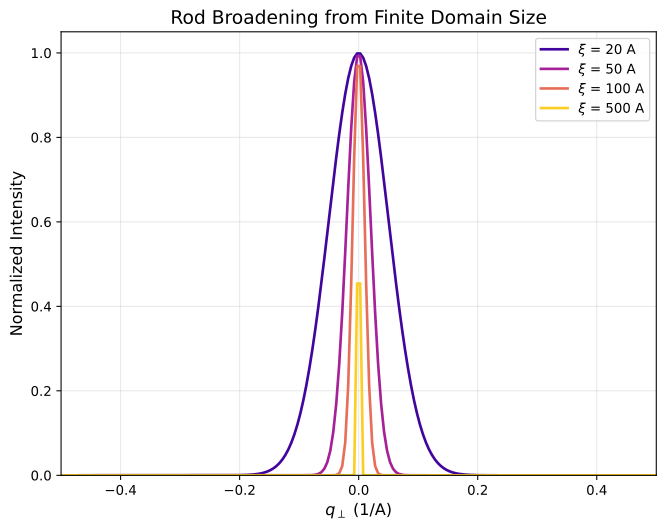
Lateral rod profiles for different coherent domain sizes. Smaller domains produce broader rods in reciprocal space, following the Fourier uncertainty relation.
Choosing a Profile
Surface Type |
Typical Profile |
Physical Reason |
|---|---|---|
High-quality epitaxial |
Gaussian |
Well-defined domain boundaries |
Polycrystalline |
Lorentzian |
Random defects |
Intermediate |
Voigt (Gaussian ⊗ Lorentzian) |
Mixed contributions |
Finite Domain Effects
Rod Broadening from Domain Size
A finite in-plane coherent domain of extent \(L\) causes reciprocal lattice rods to have width:
This follows from the Fourier uncertainty relation.
Numerical Example
Domain Size \(L\) |
Rod Width \(\sigma_{\text{rod}}\) |
|---|---|
1000 Å |
0.0025 Å\(^{-1}\) |
100 Å |
0.025 Å\(^{-1}\) |
10 Å |
0.25 Å\(^{-1}\) |
Small domains produce broad, diffuse rods.
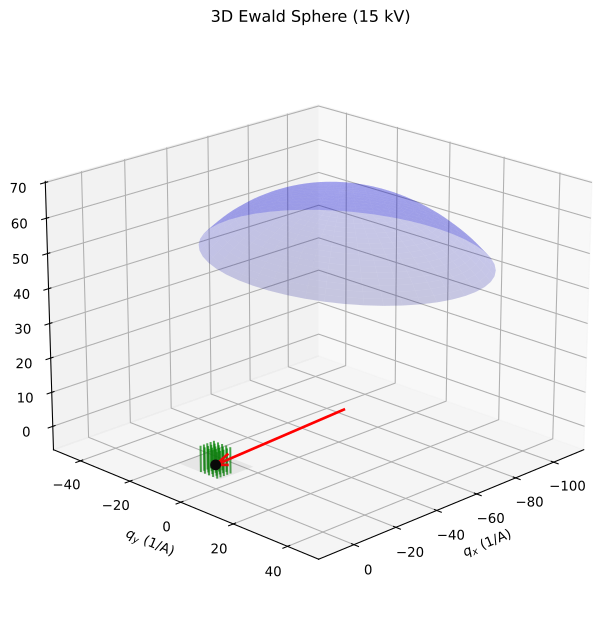
3D view of the Ewald sphere intersecting a grid of crystal truncation rods. The sphere’s curvature determines which rods are intercepted at each azimuthal angle, affecting the pattern of visible reflections.
Implementation
from rheedium.simul.finite_domain import extent_to_rod_sigma

# Domain extent in each direction
domain_extent = [100.0, 100.0, 50.0]  # Å

# Convert to reciprocal-space rod widths
sigma_rod = extent_to_rod_sigma(domain_extent)
# Returns [σ_x, σ_y] in Å⁻¹ (z-direction gives infinite rod, no σ_z)
Ewald Shell Thickness
The electron beam has finite energy spread and angular divergence, broadening the Ewald sphere into a shell.
Energy Spread Contribution
For relative energy spread \(\Delta E / E\):
(Factor of 2 because \(k \propto \sqrt{E}\))
Beam Divergence Contribution
For angular divergence \(\Delta\theta\):
Combined Shell Thickness
Adding in quadrature:
Typical RHEED Values
For a 15 keV thermionic gun RHEED system:
Parameter |
Typical Value |
|---|---|
\(\Delta E / E\) |
\(10^{-4}\) |
\(\Delta\theta\) |
1 mrad |
\(k\) |
63 Å\(^{-1}\) |
\(\sigma_{\text{shell}}\) |
0.07 Å\(^{-1}\) |
Implementation
from rheedium.simul.finite_domain import compute_shell_sigma

sigma_shell = compute_shell_sigma(
    k_magnitude=63.0,           # Å⁻¹
    energy_spread_frac=1e-4,    # Relative
    beam_divergence_rad=1e-3,   # Radians
)
# sigma_shell ≈ 0.07 Å⁻¹
Rod-Ewald Overlap
The key to finite domain simulation is computing how much each reciprocal lattice rod overlaps with the broadened Ewald shell.
Overlap Integral
For a rod at position \(\mathbf{G}\) with width \(\sigma_{\text{rod}}\) intersecting a shell of thickness \(\sigma_{\text{shell}}\):
where:
\(d = ||\mathbf{k}_{\text{out}}| - |\mathbf{k}_{\text{in}}||\) (deviation from elastic condition)
\(\sigma_{\text{eff}}^2 = \sigma_{\text{rod}}^2 + \sigma_{\text{shell}}^2\)
Weighted Intensity
The observable intensity is:
Implementation
from rheedium.simul.finite_domain import rod_ewald_overlap

overlap = rod_ewald_overlap(
    k_in=k_in_vector,       # Incident wavevector
    g_vectors=g_vectors,    # Reciprocal lattice points
    rod_sigma=sigma_rod,    # Rod widths [σ_x, σ_y]
    shell_sigma=sigma_shell,# Shell thickness
)
# overlap is Array of shape (N,) with values in [0, 1]
Rod-Ewald Intersection Geometry
For CTR simulations, rheedium solves the quadratic equation for where a continuous rod intersects the Ewald sphere.
The Quadratic Equation
For a rod extending along \(\mathbf{c}^*\) at fixed \((h, k)\):
The Ewald condition \(|\mathbf{k}_{\text{out}}| = |\mathbf{k}_{\text{in}}|\) gives:
Expanding:
where:
Solutions
The quadratic gives two \(l\) values (entry and exit of Ewald sphere through the rod):
Only solutions with:
\(l\) real (discriminant \(\geq 0\))
\(k_{\text{out},z} > 0\) (upward scattering)
contribute to the RHEED pattern.
Complete Workflow
from rheedium.simul import (
    build_ewald_data,
    finite_domain_intensities,
)

# 1. Build Ewald data (angle-independent)
ewald = build_ewald_data(
    crystal=my_crystal,
    voltage_kv=15.0,
    hmax=3, kmax=3, lmax=2,
    temperature=300.0,
)

# 2. Compute finite domain intensities
overlap, intensities = finite_domain_intensities(
    ewald=ewald,
    theta_deg=2.0,
    phi_deg=0.0,
    domain_extent_ang=[100.0, 100.0, 50.0],
    energy_spread_frac=1e-4,
    beam_divergence_rad=1e-3,
)

# 3. Apply roughness damping (optional)
from rheedium.simul.surface_rods import roughness_damping

# Get q_z for each reflection
q_z = ewald.g_vectors[:, 2]  # z-component of G vectors
damping = roughness_damping(q_z, sigma_h=2.0)
intensities_rough = intensities * damping
Physical Summary
Effect |
Mathematical Description |
Implementation |
|---|---|---|
Surface termination |
CTRs: \(I \propto 1/\sin^2(\pi l)\) |
|
Surface roughness |
\(I \times \exp(-q_z^2 \sigma_h^2)\) |
|
Finite domain |
Rod width \(\sigma = 2\pi/(L\sqrt{2\pi})\) |
|
Energy spread |
Shell width \(\sigma = k \Delta E/(2E)\) |
|
Beam divergence |
Shell width \(\sigma = k \Delta\theta\) |
|
Combined broadening |
Gaussian overlap integral |
|
Key Source Files
simul/surface_rods.py- CTR intensity and roughnesssimul/finite_domain.py- Domain and beam broadeningsimul/kinematic.py- CTR simulator