PyTree Architecture
Rheedium uses JAX PyTrees as the foundation for all data structures, enabling GPU acceleration, automatic differentiation, and efficient functional transformations across the entire simulation pipeline.
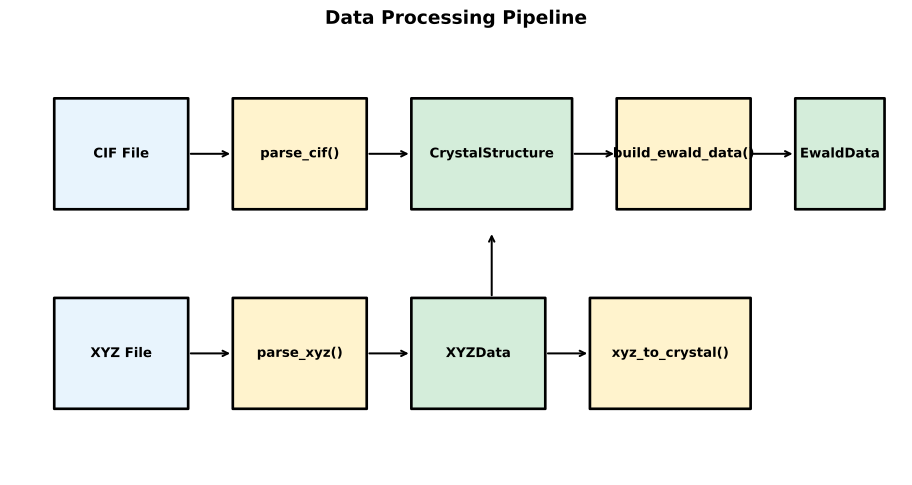
Data flow through rheedium’s PyTree-based architecture, from input file parsing through simulation to pattern output. Each box represents a PyTree-registered data structure that can be JIT-compiled and transformed.
What Are PyTrees?
A PyTree is JAX’s abstraction for nested data structures containing arrays. Any Python object registered as a PyTree can be:
JIT-compiled for GPU/TPU acceleration
Vectorized with
jax.vmapfor batch processingDifferentiated with
jax.gradfor optimizationTransformed with
jax.tree_mapfor element-wise operations
In rheedium, crystallographic data structures are registered as PyTrees, allowing seamless integration with JAX’s transformation machinery.
PyTree Classes in Rheedium
Rheedium defines 7 PyTree-registered classes across two modules:
Crystal Data Structures (types/crystal_types.py)
Class |
Purpose |
Key Fields |
|---|---|---|
|
Bulk crystal with dual coordinate systems |
|
|
Angle-independent precomputed diffraction data |
|
|
3D potential slices for multislice simulation |
|
|
Parsed XYZ file format container |
|
RHEED-Specific Structures (types/rheed_types.py)
Class |
Purpose |
Key Fields |
|---|---|---|
|
Computed diffraction pattern output |
|
|
Experimental RHEED image data |
|
|
Surface-oriented slab for simulation |
|
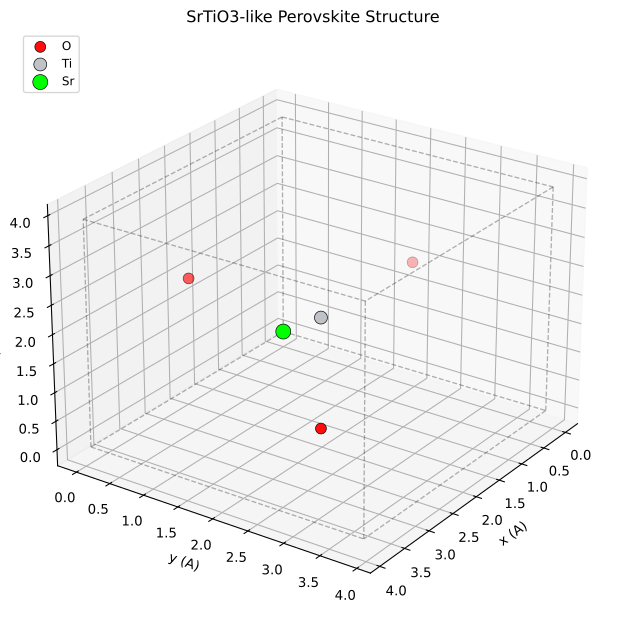
A crystal structure visualization showing the data stored in a CrystalStructure PyTree: atomic positions, cell parameters, and atomic numbers are all stored as JAX arrays that can be transformed together.
Registration Pattern
All PyTrees in rheedium follow the same pattern: NamedTuple + @register_pytree_node_class.
Why NamedTuple?
Immutability: Prevents accidental mutation, essential for functional JAX code
Named fields: Self-documenting access like
crystal.cell_lengthsinstead ofcrystal[2]Type hints: Compatible with static analysis and IDE autocompletion
Registration Example
from beartype.typing import NamedTuple
from jax.tree_util import register_pytree_node_class
from jaxtyping import Float, Int, Array

@register_pytree_node_class
class RHEEDPattern(NamedTuple):
    """JAX-compatible RHEED diffraction pattern."""

    G_indices: Int[Array, "N"]
    k_out: Float[Array, "M 3"]
    detector_points: Float[Array, "M 2"]
    intensities: Float[Array, "M"]

    def tree_flatten(self):
        """Flatten into (children, aux_data) for JAX."""
        children = (
            self.G_indices,
            self.k_out,
            self.detector_points,
            self.intensities,
        )
        aux_data = None  # No static metadata
        return (children, aux_data)

    @classmethod
    def tree_unflatten(cls, aux_data, children):
        """Reconstruct from flattened representation."""
        return cls(*children)
Children vs Auxiliary Data
The tree_flatten method separates data into two categories:
Children (Traced Arrays)
Arrays that participate in JAX transformations:
Passed through
jax.jitcompilationTraced for automatic differentiation
Mapped over with
jax.vmap
Example: All coordinate arrays, intensities, wavevectors
Auxiliary Data (Static Metadata)
Non-array data or arrays that should not be traced:
Preserved unchanged through transformations
Not differentiated
Used for reconstruction in
tree_unflatten
Example: Calibration values, string metadata, configuration flags
Example: PotentialSlices
PotentialSlices stores calibration metadata as aux_data because these values are physical constants, not variables to optimize:
@register_pytree_node_class
class PotentialSlices(NamedTuple):
    slices: Float[Array, "n_slices height width"]
    slice_thickness: float
    x_calibration: float
    y_calibration: float

    def tree_flatten(self):
        # Only the 3D array is a "child"
        children = (self.slices,)
        # Calibrations are aux_data (not traced)
        aux_data = (self.slice_thickness, self.x_calibration, self.y_calibration)
        return (children, aux_data)

    @classmethod
    def tree_unflatten(cls, aux_data, children):
        slices = children[0]
        slice_thickness, x_cal, y_cal = aux_data
        return cls(slices, slice_thickness, x_cal, y_cal)
Factory Functions with Validation
Since beartype cannot validate NamedTuple fields directly, rheedium uses factory functions that perform JAX-compatible validation before constructing PyTrees.
The Pattern
from jaxtyping import jaxtyped
from beartype import beartype
import jax.lax as lax

@jaxtyped(typechecker=beartype)
def create_rheed_pattern(
    g_indices: Int[Array, "N"],
    k_out: Float[Array, "M 3"],
    detector_points: Float[Array, "M 2"],
    intensities: Float[Array, "M"],
) -> RHEEDPattern:
    """Factory with runtime type checking."""

    # Validation happens at JIT compile time
    mm = intensities.shape[0]

    def _validate():
        # Check shape consistency
        lax.cond(
            k_out.shape == (mm, 3),
            lambda: k_out,
            lambda: lax.stop_gradient(lax.cond(False, lambda: k_out, lambda: k_out))
        )
        # Check positivity
        lax.cond(
            jnp.all(intensities >= 0),
            lambda: intensities,
            lambda: lax.stop_gradient(...)
        )

    _validate()
    return RHEEDPattern(g_indices, k_out, detector_points, intensities)
Why lax.cond for Validation?
Standard Python if statements don’t work inside JIT-compiled functions. lax.cond is JAX’s traced conditional that:
Evaluates at compile time when conditions involve static shapes
Raises errors via
lax.stop_gradientwhen the false branch is takenPreserves tracability for gradient computation
Benefits for RHEED Simulation
1. GPU Acceleration
PyTree registration enables seamless GPU execution:
import jax

@jax.jit
def compute_pattern(crystal: CrystalStructure, voltage: float) -> RHEEDPattern:
    # Entire computation runs on GPU
    ewald = build_ewald_data(crystal, voltage)
    return kinematic_spot_simulator(crystal, ewald, theta=2.0)

# First call compiles; subsequent calls are fast
pattern = compute_pattern(my_crystal, 15.0)
2. Automatic Differentiation
Optimize structure parameters against experimental data:
def loss(positions: Float[Array, "N 3"], target: RHEEDPattern) -> float:
    crystal = CrystalStructure(positions, ...)
    simulated = compute_pattern(crystal)
    return jnp.mean((simulated.intensities - target.intensities)**2)

# Gradient w.r.t. atomic positions
grad_positions = jax.grad(loss)(initial_positions, experimental_pattern)
3. Batch Processing with vmap
Compute azimuthal scans efficiently:
@jax.jit
def single_angle(phi: float) -> RHEEDPattern:
    return kinematic_spot_simulator(crystal, ewald, theta=2.0, phi=phi)

# Vectorize over 360 azimuthal angles
phis = jnp.linspace(0, 360, 360)
all_patterns = jax.vmap(single_angle)(phis)
# all_patterns.intensities has shape (360, M)
4. Functional Transformations
Apply operations to all arrays in a structure:
# Scale all positions by 1.01 (1% lattice expansion)
expanded = jax.tree_map(
    lambda x: x * 1.01 if x.ndim > 0 else x,
    crystal
)
Data Flow Through PyTrees
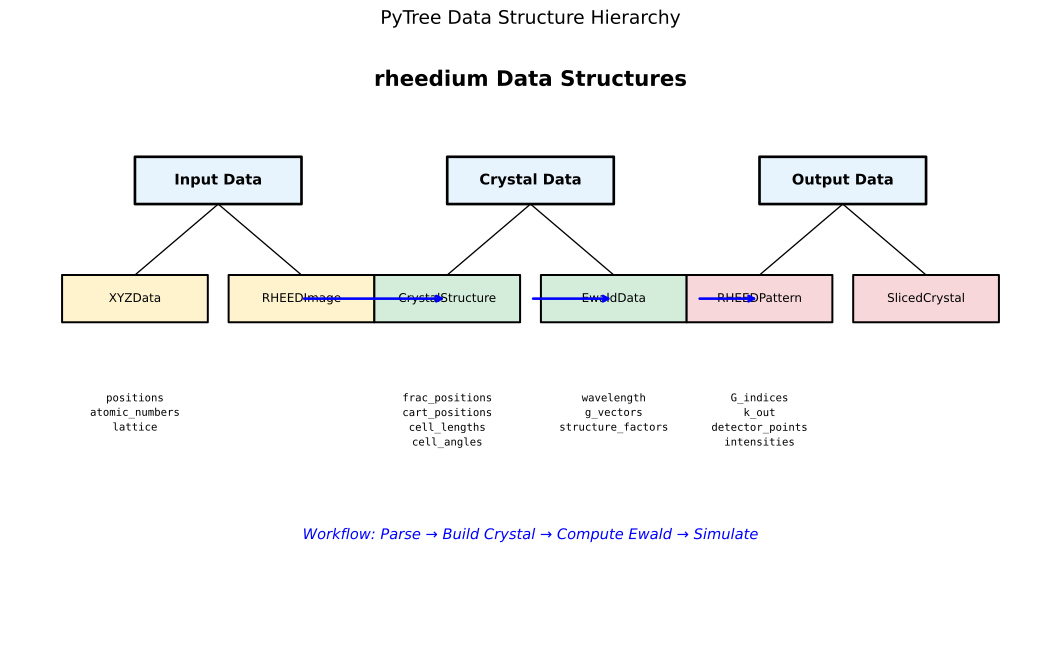
Data flow through rheedium’s PyTree structures, from input file parsing through CrystalStructure and EwaldData to the final RHEEDPattern output.
Input Files (CIF, XYZ, POSCAR)
        ↓
   parse_cif() / parse_xyz()
        ↓
┌───────────────────────────────────┐
│      CrystalStructure (PyTree)    │
│  ├─ frac_positions [N, 4]         │
│  ├─ cart_positions [N, 4]         │
│  ├─ cell_lengths [3]              │
│  └─ cell_angles [3]               │
└───────────────────────────────────┘
        ↓
   build_ewald_data()
        ↓
┌───────────────────────────────────┐
│       EwaldData (PyTree)          │
│  ├─ wavelength_ang                │
│  ├─ k_magnitude                   │
│  ├─ g_vectors [N, 3]              │
│  ├─ structure_factors [N]         │
│  └─ intensities [N]               │
└───────────────────────────────────┘
        ↓
   kinematic_spot_simulator()
        ↓
┌───────────────────────────────────┐
│      RHEEDPattern (PyTree)        │
│  ├─ G_indices [N]                 │
│  ├─ k_out [M, 3]                  │
│  ├─ detector_points [M, 2]        │
│  └─ intensities [M]               │
└───────────────────────────────────┘
Type Aliases
Rheedium defines custom type aliases in types/custom_types.py for unified scalar handling:
from typing import TypeAlias, Union
from jaxtyping import Float, Integer, Bool, Num, Array
from numpy import ndarray as NDArray

# Accept both Python scalars and 0-d JAX arrays
scalar_float: TypeAlias = Union[float, Float[Array, " "]]
scalar_int: TypeAlias = Union[int, Integer[Array, " "]]
scalar_bool: TypeAlias = Union[bool, Bool[Array, " "]]
scalar_num: TypeAlias = Union[int, float, Num[Array, " "]]

# Image array types
float_jax_image: TypeAlias = Float[Array, " H W"]
int_jax_image: TypeAlias = Integer[Array, " H W"]
float_np_image: TypeAlias = Float[NDArray, " H W"]
int_np_image: TypeAlias = Integer[NDArray, " H W"]
This allows functions to accept either Python primitives or JAX arrays transparently.
Key Source Files
types/crystal_types.py- Crystal and Ewald PyTreestypes/rheed_types.py- RHEED pattern and image PyTreestypes/custom_types.py- Type aliases